
CURA RCRP Release Outcomes
CURA RCRP is listed by the New Jersey Department of Corrections RCRP program as a male correctional treatment program in Newark. RCRP means Residential Community Reintegration Program. Placement at CURA is part of a state sentence even though the setting is in the community. The move from a prison to CURA can be an important step toward release, but it is not the final discharge event.
A departure has several possible meanings. The person may complete the program and reach the maximum end of the sentence. NJSPB may release the person on parole, which is supervised community status rather than full discharge. NJDOC may transfer the person to another RCRP, return the person to a secure state institution, or move the person for another authorized reason. The record should name the event or show the next facility. Physical absence from the Spruce Street address does not answer which outcome occurred.
| Possible CURA outcome | Best confirming source | What it means |
|---|---|---|
| Final state discharge | NJDOC Date Out-of-Custody and discharge papers | The completed state custody event is documented. |
| Parole release | NJDOC record and NJSPB decision | The person enters supervised community status. |
| Program transfer | NJDOC history or current facility | The state sentence continues at another placement. |
| Return to prison | NJDOC Current Facility and incarceration history | The person remains in state custody. |
Confirm a CURA RCRP Release
The NJDOC Offender Search is the correct first public search. It covers state correctional custody and sentence history. The Essex County Correctional Facility lookup serves the adult county jail and should not be used as the main source for CURA. Likewise, an Essex County OPRA request is directed to the wrong custodian when the requested event belongs to NJDOC.
- Accept the NJDOC portal disclaimer and search by SBI number when known. SBI is the person’s state identification number. Otherwise use the exact name and available identifiers.
- Compare aliases, sentence data, County of Commitment, and incarceration history. “Essex” as the county of commitment refers to the case venue and does not mean the person stayed in the county jail.
- Read Current Facility for present placement. Look for a past Date Out-of-Custody to confirm a completed release from NJDOC custody.
- Do not treat Current Max Release Date or Current Parole Eligibility Date as proof that release happened. Both are future-oriented fields.
- If parole may follow, request current information or the final action from the New Jersey State Parole Board.
The broader Essex County released-inmate search path helps when the last custodian is uncertain. VINE can corroborate a state custody change, and an Essex court judgment can explain the sentence. Neither replaces NJDOC’s state record. A court outcome gives the legal basis, while Date Out-of-Custody records the state event.
CURA RCRP Discharge Fields
NJDOC uses precise labels. Its official field definitions separate projected dates from completed events. Current Max Release Date is recalculated as earned reductions and disciplinary additions change, so it may move each month. Current Parole Eligibility Date marks eligibility for board consideration. It does not show that parole was granted.
- Date Out-of-Custody
- The past date on which the person left NJDOC custody. This is the main online evidence of a completed state release.
- Current Facility
- The NJDOC institution or placement presently associated with the record.
- Current Max Release Date
- A changing calculation based on the sentence, earned reductions, and disciplinary additions.
- Current Parole Eligibility Date
- The date a person becomes eligible for parole review, not an approved release date.
- Incarceration History
- Past state custody periods that help distinguish a new placement from an older release.
Maximum Term is the full sentence term. Mandatory Minimum Term is the part that cannot be shortened except through the credits recognized in the state definition. A person may remain under NJDOC or NJSPB jurisdiction until the sentence is satisfied. That is why “in the community” and “fully discharged” are not interchangeable.
CURA RCRP Release Contacts
The program can address a placement-specific question, such as whether the person remains assigned there or was moved. NJDOC is the records authority for the state correctional history. NJSPB is the authority for a parole decision, release certificate, or supervision discharge. Start with the office that created the record being requested.
CURA RCRP
53 Spruce Street
Newark, NJ
973-622-3570
NJDOC Central Office
Whittlesey Road, P.O. Box 863
Trenton, NJ 08625
609-292-4036
New Jersey State Parole Board
171 Jersey Street, Building 2
P.O. Box 862, Trenton, NJ 08625
609-292-4257
SPB-Public-Info-Office@spb.nj.gov
Ask for an identifiable existing record rather than asking an agency to investigate. Useful identifiers include the full name, SBI number, date range, CURA placement, and the record sought. For parole material, identify whether the request concerns a final decision, release certificate, present supervision information, or discharge. NJSPB also provides an official OPRA route.
New Jersey VINE, available through VINELink or by phone at 1-877-846-3465, can report custody changes from state correctional facilities. A VINE event is timely corroboration. It is not a permanent archive, and a transfer alert must not be restated as community release.
Note: CURA’s phone can clarify program placement, but NJDOC and NJSPB records establish the legal release or supervision status.
CURA RCRP State Placement
The official NJDOC RCRP page lists four community programs in Newark. The successful facility image in the project manifest comes from that state source. Review the official RCRP listing before using an address or program name.
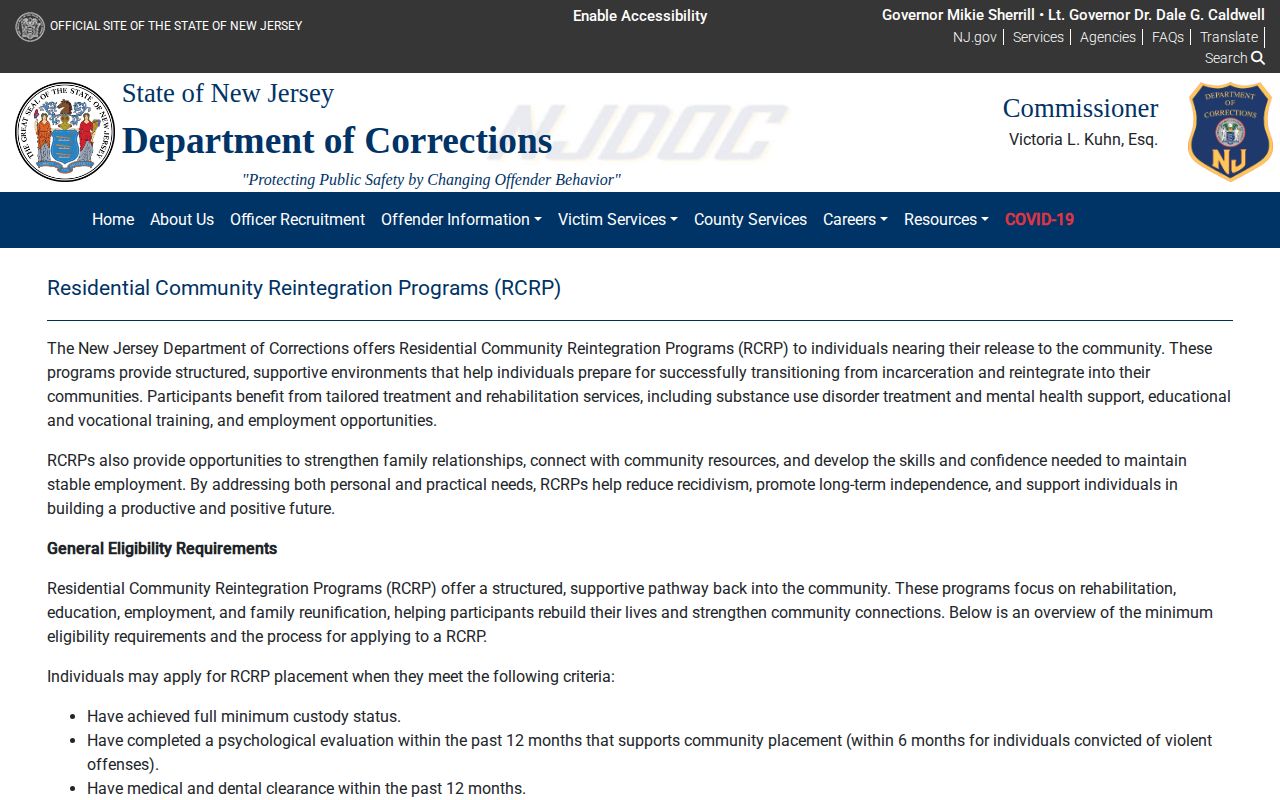
The listing places CURA within NJDOC’s community reintegration network alongside The Harbor, Tully House, and Newark-Kintock. It supports the state-record route, not an Essex County jail-release route.
This structure also explains why a person can leave a secure prison yet still be serving the state sentence. Community placement may allow treatment and reintegration work, but the legal custodian remains the state. Final release must be tied to a dated NJDOC event or parole action.
CURA RCRP Parole Records
Parole means release from prison custody into supervision by NJSPB. A parole eligibility listing is not a final decision. The Board may deny parole, set a future eligibility term, impose conditions, or rescind a grant before release. NJSPB’s weekly notice can help identify an upcoming review and sometimes preserves event notes, but it is not a full released-person database.
When the NJDOC record shows a past Date Out-of-Custody and NJSPB confirms supervision, the careful description is “released on parole,” not “fully discharged.” A later revocation can return the person to custody without erasing the fact that an earlier release occurred. Ask NJSPB for the current status when timing matters.
An Essex court record can add the sentencing context. NJ Courts routes indictable Superior Court cases through PROMIS/Gavel and provides clerk access when the electronic case jacket is incomplete. Court records may show the sentence, credits, or a later order. They do not replace the custody agency’s record of the actual departure from CURA or another NJDOC location.
Missing CURA RCRP Records
No online match is not proof of release. A name variation, identifier mismatch, transfer, older record, or portal limit can hide the expected result. Search aliases, use the SBI number, and compare the sentence and county of commitment. Then contact NJDOC with a narrow record request. The research did not verify how long discharged results remain searchable, so no retention period should be assumed.
Do not substitute the live Essex County jail roster. It answers a different custody question. Do not infer discharge because the person is no longer seen at the Newark address. The sound conclusion follows the event-plus-destination method: identify the CURA departure, locate any receiving NJDOC placement, and confirm parole or discharge through the responsible state office.
CURA RCRP Release Record Set
A complete CURA finding may require more than one record because no single field answers every part of the event. The NJDOC offender result establishes state identity, incarceration history, facility movement, and Date Out-of-Custody. Final discharge paperwork can document the completed sentence event. When parole follows, the NJSPB decision or release certificate explains the authority for supervised release, while later Board information can establish whether supervision is still active or has ended.
The Essex sentencing judgment plays a supporting role. It can confirm the offense, sentence, credits, and later court orders, but it does not replace the state custody record. VINE can add a dated custody-change notice for a recent event. Put the records in time order: sentence and placement, CURA departure, any receiving placement, Date Out-of-Custody, then parole status or final discharge. That sequence prevents a community-program move from being mislabeled as release.
If the records conflict, give the agency source priority for the event it created. Ask NJDOC about custody and discharge, NJSPB about parole, and the court about its judgment. Do not resolve a gap by guessing.