
Tully House Release Meanings
The NJDOC Residential Community Reintegration Program list identifies Tully House at Peerless Place in Newark. Education and Health Centers of America operates the educational, vocational, and work-release program within the state correctional continuum. Work release describes an authorized program status. It does not mean the person’s sentence has ended.
A resident may later reach the maximum sentence date and receive a discharge. The New Jersey State Parole Board may instead approve parole, which places the person in the community under supervision. NJDOC can transfer the resident to another RCRP or return the resident to a secure institution. Each outcome leaves a different record trail. The key is to identify both the Tully House departure and the next custodian or supervision authority.
| Observed event | What it may mean | Record to check |
|---|---|---|
| No longer at Tully House | Discharge, parole, transfer, or return | NJDOC history and program contact |
| Past Date Out-of-Custody | Completed NJDOC custody event | NJDOC offender record |
| Parole decision | Community supervision follows | NJSPB final action |
| New Current Facility | State custody continues elsewhere | NJDOC Current Facility |
Confirm Tully House Releases
Start at the NJDOC Offender Search. It is the state-prison and state-program route. The Essex County Correctional Facility lookup is a live county-jail tool and does not control Tully House records. County OPRA also cannot produce an NJDOC discharge merely because Tully House is physically in Essex County.
- Search by SBI number if it is known. Otherwise enter the exact name and compare all possible matches.
- Match aliases, sentence, offense, county of commitment, and incarceration history. County of Commitment “Essex” identifies the case venue, not the current facility.
- Read Current Facility to see whether another NJDOC location now appears. A receiving facility supports transfer rather than final release.
- Look for a past Date Out-of-Custody. That field confirms a completed release from NJDOC custody.
- When parole is possible, contact the New Jersey State Parole Board information office for the final decision or present supervision status.
VINE can add a timely custody-change notice for New Jersey correctional facilities. A court judgment can explain the sentence or later order. Neither source should be read alone. The Essex County release search provides the branching path when the last custodian is unclear, but a Tully House record remains a state matter.
Tully House Release Date Fields
NJDOC’s field definitions draw a firm line between forecasts and completed events. Current Max Release Date is the state’s changing calculation. Earned reductions and disciplinary additions can alter it each month. Current Parole Eligibility Date shows when parole review becomes possible. It is not a grant and does not guarantee departure on that day.
- Date Out-of-Custody
- The retrospective field for the date a person left NJDOC custody.
- Current Max Release Date
- A future calculation that can change as credits and additions change.
- Current Parole Eligibility Date
- An eligibility marker, not a final NJSPB release decision.
- Current Facility
- The state location or program presently tied to the record.
- Incarceration History
- Past state custody periods used to place a Tully House stay in context.
A past Date Out-of-Custody should be paired with the incarceration history and any NJSPB record. If parole follows, the person has left the institution but remains under supervision. If a new facility appears, the supported result is transfer. The research did not establish how long discharged records remain online, so older events may require a focused NJDOC records request.
Tully House Release Contacts
Tully House can answer program-specific administrative questions. NJDOC maintains the state custody record. NJSPB controls parole actions and supervision records. Direct a request to the office that made the event, and include enough detail to identify an existing record.
Tully House - The Harbor
28 Peerless Place
Newark, NJ
973-297-1771
NJDOC Central Office
Whittlesey Road, P.O. Box 863
Trenton, NJ 08625
609-292-4036
New Jersey State Parole Board
171 Jersey Street, Building 2
P.O. Box 862, Trenton, NJ 08625
609-292-4257
SPB-Public-Info-Office@spb.nj.gov
For NJDOC, identify the full name, SBI number if known, Tully House placement, date range, and the discharge, transfer, or incarceration-history record sought. For NJSPB, state whether the request concerns a final parole decision, release certificate, supervision status, or discharge from parole. A weekly eligibility notice can locate a scheduled matter, but it is not a complete decisions search.
New Jersey VINE is available at VINELink and 1-877-846-3465. Registering for a custody-change notice can help with a current case. VINE is corroboration, not a permanent archive, and a transfer notice is not final community discharge.
Note: A precise request for a dated record is more useful than asking an agency to decide whether someone is generally “free.”
Tully House State Program
The state RCRP list is the manifest-approved visual source for Tully House. The official NJDOC community-program page shows Tully House among four Newark placements.
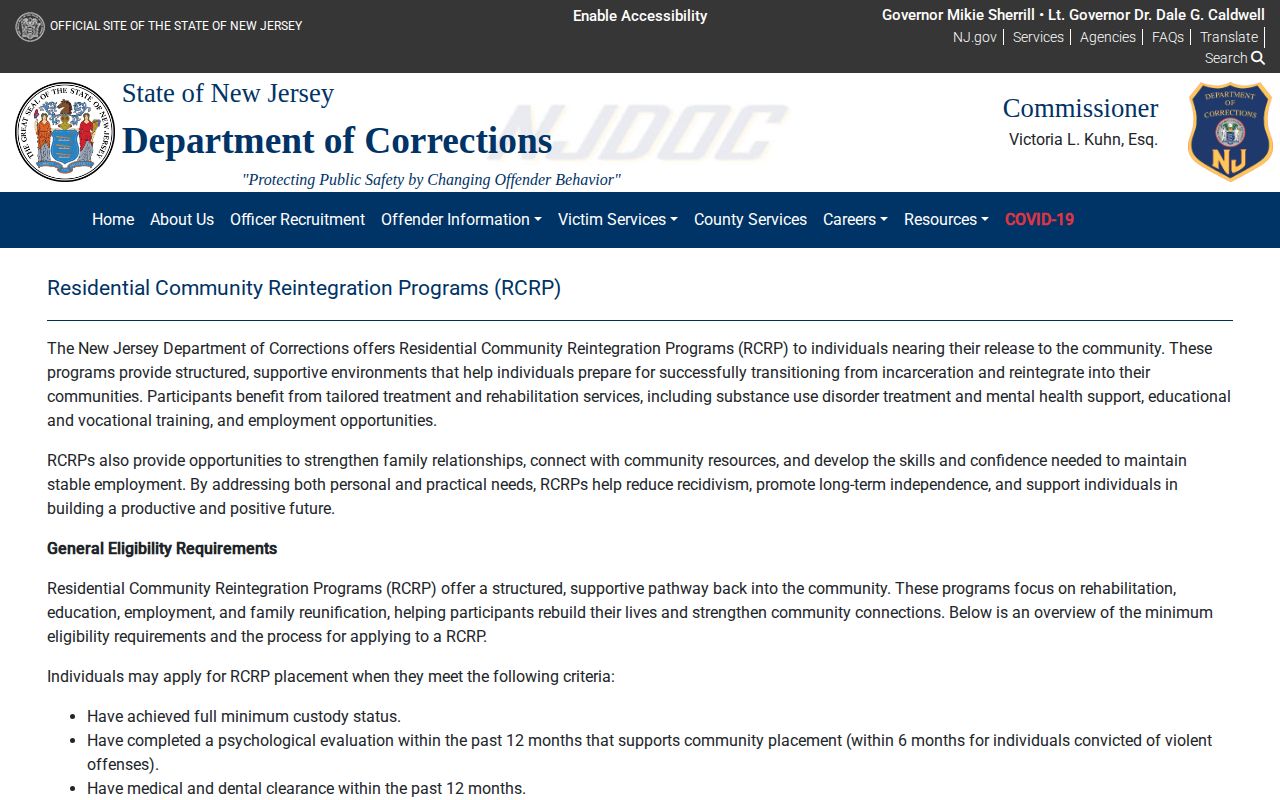
The source groups Tully House with The Harbor Assessment and Treatment Center, CURA RCRP, and Newark-Kintock. That shared state listing explains why NJDOC, rather than the county jail, is the main records lane.
The program’s work-release focus is a meaningful local detail. It can permit approved work activity while custody and sentence controls remain in place. A person seen at work or away from the residence may still be assigned to Tully House. Conversely, someone who leaves the program may have been transferred back to a secure institution. Only the official state history resolves that difference.
Tully House Parole Status
Parole is a supervised release authorized by NJSPB. Eligibility, approval, and actual release are separate stages. The weekly county-organized notice can show a name, identification number, sentence details, location, offense, and event notes. It is an eligibility and scheduling publication, not a public name-searchable database of everyone now on parole.
A grant may be followed by conditions, delay, or rescission. If NJDOC shows Date Out-of-Custody and NJSPB confirms active supervision, describe the event as parole release. Full discharge comes later when the legal supervision term ends. A revocation may return the person to custody, so current status should be checked when a past release is found.
Essex court records can explain the original sentence. PROMIS/Gavel serves Superior Court indictable matters, while a clerk record may be needed when the electronic case jacket is incomplete. The court record does not timestamp the door at Tully House. NJDOC and NJSPB remain the better sources for the physical and supervision events.
Missing Tully House Records
A missing online result can reflect a spelling difference, alias, identifier mismatch, move to another NJDOC placement, an older discharge, or a portal limit. Try the SBI number and compare incarceration history. Then ask NJDOC for the relevant existing record. No verified retention duration for discharged online results was found.
Do not use the Essex jail roster as a substitute. It answers whether a person appears in current county custody, not whether a state-sentenced Tully House resident was discharged. A sound finding identifies the departure, checks the next state location, and confirms parole or final discharge with the proper state agency.
Tully House Work-Release Status
Tully House’s educational, vocational, and work-release role creates a specific source of confusion. Approved activity outside the residence may be part of the program while NJDOC jurisdiction continues. Seeing a resident in the community does not prove parole or discharge. The same is true when a resident works on a regular schedule. Program participation and legal release are separate facts.
The reverse inference is also unsafe. A person who stops reporting to a known workplace or is no longer present at Peerless Place has not necessarily reached the end of the sentence. NJDOC may have moved the person to another community program or secure facility. Current Facility and incarceration history are the first fields to inspect. A dated program record can clarify the movement, while Date Out-of-Custody confirms the completed state event.
Build the record in sequence. First identify Tully House as the state placement. Next document the departure and any receiving facility. Then check NJSPB for a final parole action. If no supervision follows and NJDOC records a completed release, request the final discharge paperwork when formal proof is needed. This sequence keeps a daily work-release privilege, a program transfer, parole release, and maximum-date discharge from being compressed into the same label.
An Essex sentencing record adds context but not the final answer. It can show the term, credits, and later court orders. NJDOC records the custody event, and NJSPB records parole. Use each source for its own part of the timeline.